
Can hypnotherapy help with procrastination?
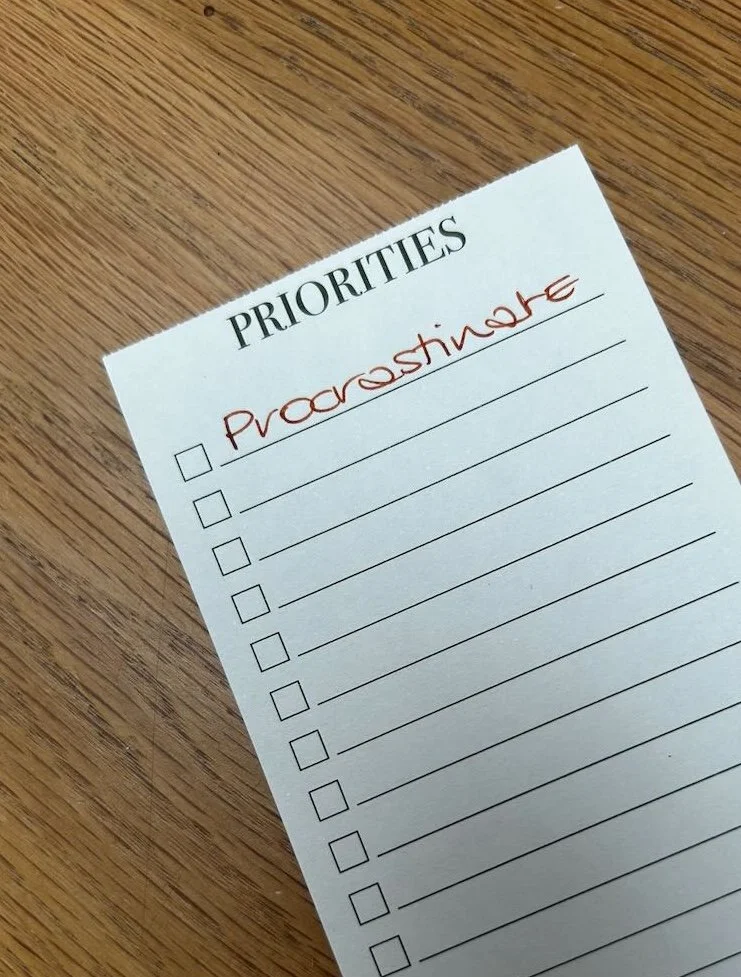
There’s an odd thing about procrastination.
We procrastinate not because we don’t know what we need to do, or we’re confused about what’s on the list or even we doubt our ability to do it.
We just… don’t do it.
I’m sure you know the feeling. You make a ‘commitment’ to yourself that today’s the day to get that certain thing done. You hear the words in your head. And then, with them still ringing in your ears, you’re already doing something else. Something not needing to be done right now, or something that’s just a distraction.
We procrastinate – and then we berate ourselves for it.
But that behaviour makes sense when we understand what's going on in our brains.
It’s not about willpower
Procrastination isn’t about being lazy or weak-willed. It is about our brain’s state.
When our brains perceive a task as risky, ambiguous, or likely to expose us to failure or criticism, something shifts. Resources move away from action and toward self-preservation. And crucially, this happens independently of how intelligent we are or how capable we are. We can be competent and still spend an afternoon doing anything except the one thing that matters.
Research using brain imaging shows this. The prefrontal cortex - the area responsible for planning and goal-directed thinking - shows reduced activity during procrastination. Meanwhile, the limbic system, which processes threat and emotion, becomes more active. (He, 2016; Rabin et al., 2011). The nervous system is essentially saying: ‘This doesn't feel safe. Let's do something else instead’.
More recent research adds another piece. When the brain can't vividly imagine a meaningful payoff, the discomfort of beginning, wins every time (Le Bouc and Pessiglione, 2022). It’s not laziness, it’s the nervous system trying to escape discomfort.
The other side: precrastination
Not everyone procrastinates. Some of us do the opposite - we start tasks far too early, rushing through things and often at the expense of quality or clear thinking.
This is precrastination (Rosenbaum et al., 2014). It’s the tendency to complete or begin tasks as soon as possible, even if it means extra effort or a worse outcome. Submitting work before it's had time to breathe, making decisions before all the relevant information is in, answering an email as soon as it comes in.
The underlying driver is the same as procrastination - just expressed differently. The unfinished task nags, and having it sit there, ‘not done’, feels uncomfortable, so we act early just to get rid of it.
What's worth noticing is that both patterns - waiting too long and acting too quickly - share a common thread. Both are the nervous system trying to escape discomfort. The surface behaviour looks different; the underlying mechanism is similar.
How hypnotherapy can help procrastination and precrastination
Because procrastination is fundamentally an anxiety and emotional regulation problem, the approaches that work best aren’t the ones you’d expect. We don’t need to make more lists, plan more or manage time better. None of these touch the real issue.
If our nervous system is still treating the task as a threat, no amount of restructuring the calendar will change that. We don't need more discipline, we need our nervous system to feel safer.
Hypnotherapy helps because hypnosis changes the brain state in which all that processing happens. Your brain enters a state where it becomes more receptive to updating the associations you hold - the ones such as ‘this is dangerous’ or ‘I won't be good enough’ - and replacing them with something that better reflects reality.
For ‘procrastinators’, hypnosis allows you to rehearse different thoughts and responses in a brain state where they can take root. For those who tend to precrastinate, the work is about learning to tolerate the discomfort of something being as yet unfinished.
And if you're curious what an actual first session looks like, here's what to expect at your first hypnotherapy session.
A realistic picture
Procrastinating doesn’t mean you’re lazy or weak-willed. Somewhere along the way, your brain learned that certain kinds of tasks aren't entirely safe to attempt. That learning isn't fixed and with the right support, it changes. The same goes for precrastination. The work is in trusting in a slower process and recognising that the urge to close things off quickly is something worth listening to.
If you'd like to find out whether hypnotherapy might be a good fit for you to explore your procrastination or precrastination, I'd love to have an initial conversation, so do book a free, no-obligation Consultation Call with me.
References:
He, S. (2016). Identifying the neural substrates of procrastination: A resting-state fMRI study. Scientific Reports, 6, 33203. https://doi.org/10.1038/srep33203
Le Bouc, R., Pessiglione, M. A neuro-computational account of procrastination behavior. Nat Commun 13, 5639 (2022). https://doi.org/10.1038/s41467-022-33119-w
Rabin, L. A., Fogel, J., & Nutter-Upham, K. E. (2011). Academic procrastination in college students: The role of self-reported executive function. Journal of Clinical and Experimental Neuropsychology.
Rosenbaum, D.A., Gong, L., & Potts, C.A. (2014). Pre-crastination: Hastening subgoal completion at the expense of extra physical effort. Psychological Science, 25(7), 1487–1496.
Common Questions About Procrastination and Precrastination
Can hypnotherapy help with procrastination, or is it just relaxation?
Hypnosis as part of hypnotherapy produces a state of deep relaxation, but that's the doorway and not the destination. What matters is what happens in that state. Your brain becomes more receptive to updating the associations it holds around particular tasks. Because procrastination is driven by anxiety and threat responses rather than laziness, working at the level of the nervous system can produce more lasting change than conscious effort or productivity strategies alone.
Can hypnotherapy help with precrastination?
Learning to slow down is part of the work, but it goes deeper than that. Precrastination is driven by the discomfort of holding something unfinished. Your nervous system would rather act too early than sit with that unresolved feeling. Hypnotherapy helps by creating a brain state in which it becomes easier to tolerate that discomfort, updating the association between an unfinished task and threat. Over time, the urge to rush loses its grip, and there's more space to think, reflect, and produce better work as a result.
Is procrastination a sign of ‘laziness’?
No - and this is one of the most persistent myths about procrastination. Brain imaging shows reduced activity in the prefrontal cortex (the planning, goal-directed part of the brain) during procrastination, alongside increased activity in the limbic system, which processes threat. Your brain isn't being lazy. It's treating the task as unsafe in some way, even when you consciously know it isn't.
Why do I procrastinate on things I actually want to do?
Because the trigger usually isn't about motivation - it's about how risky, ambiguous, or exposing the task feels to your nervous system. A task can matter to you a great deal and still get flagged as threatening if it carries the possibility of failure, judgement, or getting it wrong. Wanting to do something and feeling safe enough to start it are two different things.
What's the difference between procrastination and precrastination?
Procrastination is putting a task off longer than intended; precrastination is doing the opposite — rushing to complete or begin something as early as possible, even at the cost of extra effort or a worse result. They look like opposite behaviours, but the underlying driver is the same: the discomfort of an unresolved task, handled in different directions.
Can you be both a procrastinator and a precrastinator?
Yes, and many people are, depending on the type of task. You might rush to answer emails the moment they arrive but put off a big, ambiguous project for weeks. Both patterns come from the same root - a nervous system trying to offload the discomfort of something feeling unfinished - just expressed differently depending on what the task triggers.