
Anxiety: Why sometimes everything feels too much (or nothing at all)

You know those days when you can handle pretty much anything?
Someone cuts you off in traffic and you shrug it off. A difficult email arrives and you deal with it calmly. Unexpected plans change and you adapt without much fuss. You feel present, capable, reasonably steady.
And then there are the other days.
The ones where the smallest thing - a tone of voice, a minor inconvenience, even just too many decisions to make - tips you completely over the edge.
Suddenly you're snapping at people, or you feel yourself getting worked up, or you disconnect, and can't seem to care about anything at all.
What's changed?
Often, it's not the situation itself. Rather, it's where you are in relation to your Window of Tolerance.
What is the Window of Tolerance?
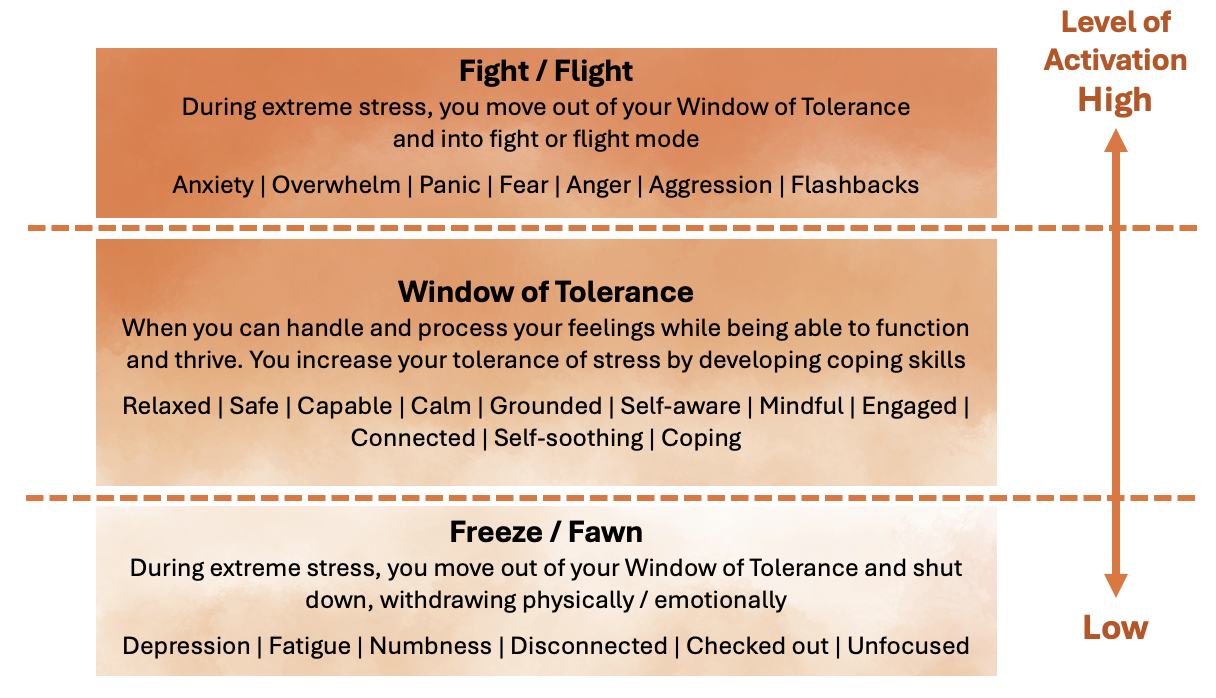
The Window of Tolerance (Siegel, 1999) describes the optimal zone of arousal where we can function at our best - where we can think clearly, manage our emotions, and respond to stress in healthy ways.
Think of it as a range. When we're within our Window, we can handle life's ups and downs without becoming overwhelmed or shutting down. We feel reasonably grounded, present, and able to cope.
But we don't stay in that Window all the time. When stress, anxiety, trauma, or even just accumulated pressure pushes us outside of this ‘Window’, we move into one of two states: hyperarousal or hypoarousal.
What happens outside the Window?
Understanding what happens when we leave our Window of Tolerance can help us recognise these states in ourselves and means we can then do something about this.
Hyperarousal: When your system revs too high
When you move into hyperarousal, your nervous system has essentially hit the accelerator. This is your fight-or-flight response kicking in.
You might notice:
Racing heart or rapid breathing
Feeling panicky, anxious, or ‘on edge’
Hypervigilance - scanning for threats, unable to relax
Irritability or anger that feels disproportionate
Racing thoughts or difficulty concentrating
Feeling overwhelmed or like everything is too much
In hyperarousal, your nervous system has decided there's danger and is preparing you to fight or flee. The problem is, this response often gets triggered by things that aren't actual threats; a difficult conversation, a packed schedule, accumulated stress.
Hypoarousal: When your system shuts down
On the other side of your Window of Tolerance is hypoarousal. This is when your nervous system hits the brakes hard. This is the freeze or fawn response.
You might notice:
Feeling numb, disconnected, or ‘not really here’
Low energy or exhaustion that sleep doesn't fix
Difficulty thinking clearly or making decisions
Feeling foggy or spacey
Withdrawal from others or activities
A sense of hopelessness or flatness
In hypoarousal, your nervous system has essentially decided that fighting or fleeing won't work, so it's shutting down to conserve energy and protect you. You might describe it as feeling ‘checked out’ or going through the motions without really being present.
The science: your nervous system and the polyvagal theory
To understand why this happens, it helps to know a bit about how your nervous system works.
Polyvagal theory (Porges, 2018) explains that we have three main nervous system states, controlled by the vagus nerve:
Ventral vagal (social engagement system): This is your Window of Tolerance. When this system is active, you feel safe, connected, and able to engage with the world. Your heart rate is steady, your breathing is calm, and you can think clearly.
Sympathetic (mobilisation system): This is hyperarousal - your fight-or-flight response. When your nervous system perceives threat, the sympathetic system activates to mobilise energy and prepare you to respond.
Dorsal vagal (immobilisation system): This is hypoarousal - your freeze or shutdown response. When the sympathetic response doesn't resolve the threat (or when the threat feels overwhelming), the dorsal vagal system takes over and immobilises you.
Your nervous system is constantly scanning for cues of safety or danger. This happens unconsciously, below your awareness. And sometimes, especially if you've experienced trauma or chronic stress, your nervous system can become sensitised; perceiving threat when there isn't any real danger.
When that happens, your Window of Tolerance narrows. Things that wouldn't have bothered you before suddenly push you outside your window.
Why your Window might be narrow right now
Several factors can narrow your Window of Tolerance:
Chronic stress gradually depletes your capacity to cope. If you've been managing a lot for a long time be they work pressures, caring responsibilities, health challenges, relationship difficulties, you’ll find that your nervous system is already working overtime.
Past trauma or difficult experiences can leave your nervous system on high alert, making it easier to tip into hyperarousal or hypoarousal.
Life transitions - even positive ones like moving house, changing jobs, or becoming a parent - require adjustment and can temporarily narrow your Window.
Physical factors such as poor sleep, inadequate nutrition, lack of movement, or health conditions all affect your nervous system's resilience.
Lack of connection or support can keep you outside your Window because connection is one of the primary ways our nervous system regulates itself.
The aim: expanding your Window
The good news is that your Window of Tolerance doesn’t have a fixed width. You can expand it and therefore increase your capacity to stay present and regulated even when life gets challenging.
This doesn't mean you'll never feel stressed or upset. It means you'll be able to handle more before tipping into hyperarousal or hypoarousal, and you'll recover more quickly when you do leave your window.
How to expand your Window of Tolerance
#1 Recognise when you're outside your window
The first step is simply noticing. When you feel yourself becoming overwhelmed, anxious, or numb, pause and ask: "What’s going on with me at the moment? Is everything feeling too much right now (hyperarousal) - or am I feeling a little disconnected (hypoarousal)?" This awareness alone can help. You're moving from being swept away by the state to observing it - and that’s the first step toward regulating it.
#2 Grounding techniques
Grounding brings you back into your body and the present moment, which helps bring you back toward your window.
Try the 5-4-3-2-1 technique: Notice five things you can see, four things you can touch, three things you can hear, two things you can smell, and one thing you can taste. This engages your senses and interrupts the stress response. Physical grounding also works. Feel your feet on the floor. Press your hands together. Hold something with texture or temperature - ice cubes, a warm mug, a smooth stone.
#3 Breathing practices
Your breath is one of the most direct ways to influence your nervous system.
For hyperarousal (when you're revved up), try extended exhale breathing. Breathe in for a count of seven, then out for a count of eleven (not eleven seconds!!). The longer exhale activates your parasympathetic nervous system and signals safety.
For hypoarousal (when you're shut down), try energising breathing. Take deeper, fuller breaths or try breath of fire (quick, rhythmic breathing through the nose). This can help mobilise energy and bring you back up toward your Window.
#4 Movement
Gentle movement helps discharge stress and bring you back into your body. This doesn't mean intense exercise as it can be as simple as stretching, shaking out your limbs, going for a walk, or dancing to a song you love. The key is movement that feels good and sustainable, not punishing.
#5 Connection
Your nervous system co-regulates with others. Being with someone who feels safe and calm can help bring you back into your own Window. This might be talking to a friend, sitting quietly with someone you trust, or even petting an animal. Connection signals safety to your nervous system.
#6 Hypnotherapy
Hypnotherapy can be particularly effective for expanding your window of tolerance because it works directly with your nervous system.
In hypnosis, you enter a deeply relaxed state where your nervous system can reset. We can work on building your capacity to stay present with difficult feelings, processing experiences that narrowed your Window, and creating new responses to stress.
Through techniques such as ego strengthening and resource building, hypnotherapy helps you develop an internal sense of safety and resilience that expands your window over time.
#7 Small, consistent practices
Expanding your Window isn't about dramatic interventions. It's about small, consistent practices that signal safety to your nervous system over time.
This might look like: a few minutes of grounding each morning, regular breathing practice, prioritising sleep, moving your body daily, staying connected to supportive people, and working with a therapist to process what's keeping your Window narrow.
A final thought
Understanding your Window of Tolerance isn't about never feeling overwhelmed or shut down ever again. It's about recognising what's happening when you do, knowing you have options, and gradually building your capacity to stay present with life's challenges.
Your nervous system is trying to protect you. When you move outside your Window, it's doing what it thinks is necessary to keep you safe. The work is gently teaching it that you're safe more often than it thinks - and giving it the tools to come back to regulation when stress does push you outside your Window, and to expand the Window itself.
If you're finding that you're spending a lot of time outside your Window of Tolerance - if hyperarousal or hypoarousal has become your baseline rather than the exception - that's worth exploring with support.
Hypnotherapy can help you understand what's narrowing your window and gradually expand it so that you have more capacity, more presence, and more choice in how you respond to life. If you would like to know more - or to talk through how we might work together - do get in touch.
References:
Porges, S. W. (2018). Polyvagal Theory: A primer in Porges, S. W. & Dana, D. (eds.) Clinical applications of the polyvagal theory: The emergence of polyvagal-informed therapies. W. W. Norton & Company, pp.50-69.
Siegel, D. J. (1999). The Developing Mind: How Relationships and the Brain Interact to Shape Who We Are (3rd Edition). New York: The Guilford Press.